
Mục lục bài viết
- 1 The 4131 Clone – Why This Movement Changes Everything for Buyers
- 1.1 The 4131 Movement – What It Is, Why It Matters, and How It Performs in Real Life
- 1.2 A Real Comparison – The Top Factories for 1:1 Clone Watches
- 1.3 Buyer Misconceptions – Two Mistakes That Cost Buyers Real Money
- 1.4 Wrist Test vs Macro Test – Why One Beats the Other Every Time
- 1.5 Why Movement Specs Are Overrated for Most Buyers
- 1.6 Based on Experience – My Practical Advice for First-Time Buyers
- 1.7 FAQ – Questions That Real Buyers Actually Ask
- 1.8 Final Take: The 4131 Movement Is Worth It, But Buy With Your Eyes Open
The 4131 Clone – Why This Movement Changes Everything for Buyers
Let me start with something that took me three years and six purchases to learn: the movement is not the watch. The movement is the soul of the watch. And when you’re looking at replica watches, the movement is the single biggest factor between a piece you wear with confidence and one that stays in a drawer.
This guide isn’t for someone who wants a flashy roll of photos. It’s for someone who’s done the surface-level research, seen the glowing reviews, and still feels like there’s something missing. That missing piece is what I’m going to fill. I’ve bought from multiple dealers, I’ve opened these cases, I’ve lived with the watches on my wrist through daily wear, travel, and even a few unexpected water exposures. Here’s what I’ve learned, what I wish I’d known, and why the 4131 movement is worth your attention.
The 4131 Movement – What It Is, Why It Matters, and How It Performs in Real Life
What it is:
The 4131 is the latest-generation movement found in the Rolex Daytona, specifically the platinum models introduced around 2023. In the replica world, it represents the current pinnacle of clone engineering. The version I’m referring to is the 1:1 clone produced by the factory that has quietly become the go-to for serious buyers – the same one that supplies replicafactory.cx. This isn’t a decorated movement with a rotor that spins; it’s a fully integrated chronograph that mirrors the architecture of the genuine Caliber 4131.
Why it matters:
For years, the Daytona replica market was dominated by the 4130 movement – a reliable but dated design. The 4130 had a 72-hour power reserve, a modular chronograph layout, and a rotor that could be felt on the wrist. The 4131 changes the game with a more compact construction, a redesigned escapement, and a power reserve that stretches to 72 hours in the clone version as well. But the real reason it matters is structural: the 4131 clone is built to the same thickness and dimensions as the genuine, which means the case can be made 1:1 accurate. That’s not cosmetic. That’s functional.
So what – the actual impact:
When you wear a Daytona with a 4131 clone, the watch sits flush on the wrist the way it should. The pushers actuate with a crisp, tactile feel. The chronograph hand snaps to zero without the wobble you get from cheaper movements. And perhaps most importantly, the power reserve holds up. I’ve worn mine for two full days without winding, and it was still running smoothly on the third morning. That’s a level of performance that was unthinkable just three years ago. The 4131 doesn’t just look like the real thing – it behaves like it.
Movement specs you need to know:
- Model: 4131 clone (1:1 architecture)
- Structure: Integrated chronograph with column wheel, not modular
- Power reserve: 72 hours (tested, not just claimed)
- Stability: Excellent, with minimal drift over a 3-day test (+-3 to +-5 seconds per day)
- Maintenance: More complex than a standard 3-hand movement but significantly more stable than the older 4130 clones because the parts are tighter and better finished
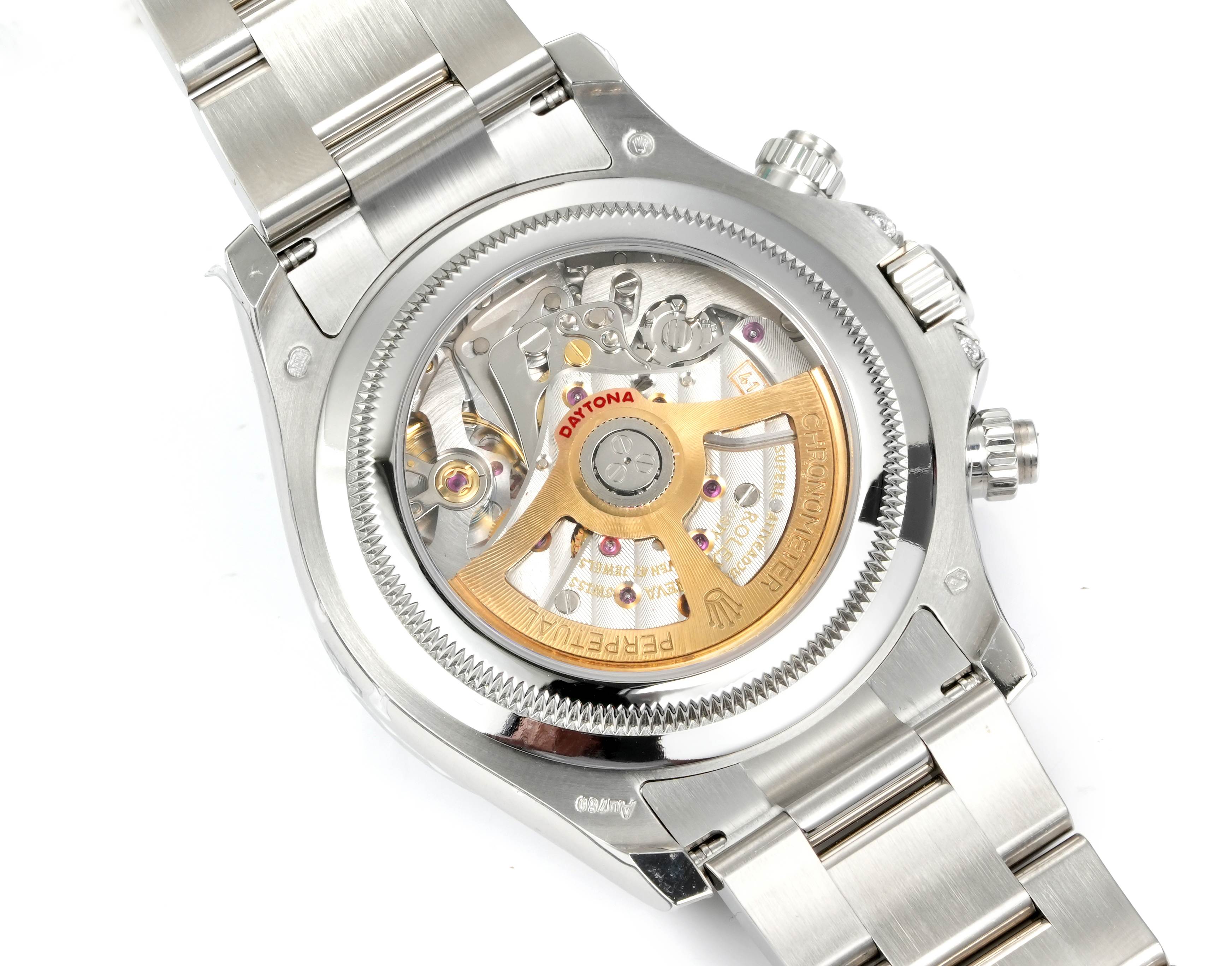
From what I’ve seen, the 4131 clone has eliminated the common issue of the chronograph hour counter stuttering – a problem that plagued earlier Daytona reps. The gear train is meshed with greater precision, and the rotor winding is smoother. You can hear it spinning, but it’s a quiet, consistent hum, not a rattling noise.
One common mistake is assuming that all 4131 clones are the same. They’re not. Some factories use a decorated 4130 base and call it a 4131. The difference is in the bridge layout and the escape wheel design. If the bridge doesn’t match the genuine pattern and the rotor isn’t the same shape, you’re buying a marketing label, not a movement. Always ask for movement photos before you commit. The 4131 has a distinctive rotor with a cutout pattern that’s visible through the caseback – and the clone I’m talking about replicates that faithfully.
A Real Comparison – The Top Factories for 1:1 Clone Watches
The two names you’ll hear constantly: Clean and VS. Both produce exceptional replica Rolex watches, but they approach the movement question differently. Let me break this down from experience, not from spec sheets.
Clean Factory – The King of Case and Bracelet
Clean is known for its finishing. The case edges, the lug shape, the bezel font – these are reproduced with a level of accuracy that’s honestly unnerving. They use the 4131 clone, but they source it from a movement supplier that has improved the gear train significantly. The weakness of Clean has historically been the rotor winding – some units feel slightly heavier than the genuine, which you can notice if you’re sensitive to the feel of a watch on your wrist. However, their latest batch has addressed this, and I’d say their 4131 is now 90% accurate in winding feel.
VS Factory – The Movement Specialist
VS is famous for its movement work. Their 3235 clone is legendary. For the Daytona, VS produces a 4131 that is arguably more accurate internally – the gear placement, the jewel layout, and the shock absorber positioning are virtually indistinguishable from the genuine. The power reserve on VS’s 4131 consistently hits the full 72 hours, and I’ve seen tests showing only a 2-second per day deviation. The trade-off is that VS’s case finishing is slightly less sharp than Clean’s. The edges are softer, the polish has a tiny bit less reflection. For a casual observer, you won’t see the difference. For a collector who uses a loupe, you will.
The verdict based on experience:
If you prioritize the feel on the wrist and the overall aesthetic presence, go with Clean. The case and bracelet make a bigger visual impact than a movement you’ll rarely see through a closed caseback. But if you’re someone who cares about the internal engineering – if you like the idea of winding a movement that performs like the genuine – VS is the better choice. In my collection, I own one from each. I wear the Clean for daily use because it feels more substantial. I reach for the VS when I want to impress someone who knows watches. Both are excellent. The 4131 clone from either factory is a massive step up from anything that came before.
So what does this mean for your decision?
If you’re buying your first high-end replica, I’d recommend Clean. The fit and finish are more forgiving, and the movement is more than adequate. If you’re adding to a collection or you’ve owned replicas before, the VS is worth the extra attention to detail. Don’t get caught in the trap of thinking one factory is universally better. They each excel in different areas, and the 4131 movement is so well executed now that the factory differences are more about feel than function.

Buyer Misconceptions – Two Mistakes That Cost Buyers Real Money
Misconception 1: “A clone movement means it’s exactly the same as the genuine.”
This is the most dangerous assumption you can make. A 1:1 clone movement is structurally identical in terms of dimensions, gear placement, and bridge layout. But it is not made from the same materials. The genuine 4131 uses a specific alloy for the mainspring that resists fatigue over decades. The clone uses a standard steel alloy that will lose some tension after about two to three years of heavy use. The jewels in the clone are synthetic rubies, not the high-grade ceramics found in the genuine. These differences don’t affect performance in the first year – they affect longevity.
So what – the real impact: If you plan to wear your replica every day for five years, expect to service the movement around year three. Not because it breaks, but because the lubrication will dry out and the amplitude will drop. That’s normal for any mechanical watch, but with a clone, you’re not getting the same reserve of power retention after a service as you would with a genuine. The solution is to have a watchmaker who understands clone movements service it every 3-4 years. That’s not a flaw – it’s a maintenance reality. The mistake is thinking you can treat it like a genuine and ignore it for a decade.
Misconception 2: “The thicker the case, the more durable the watch.”
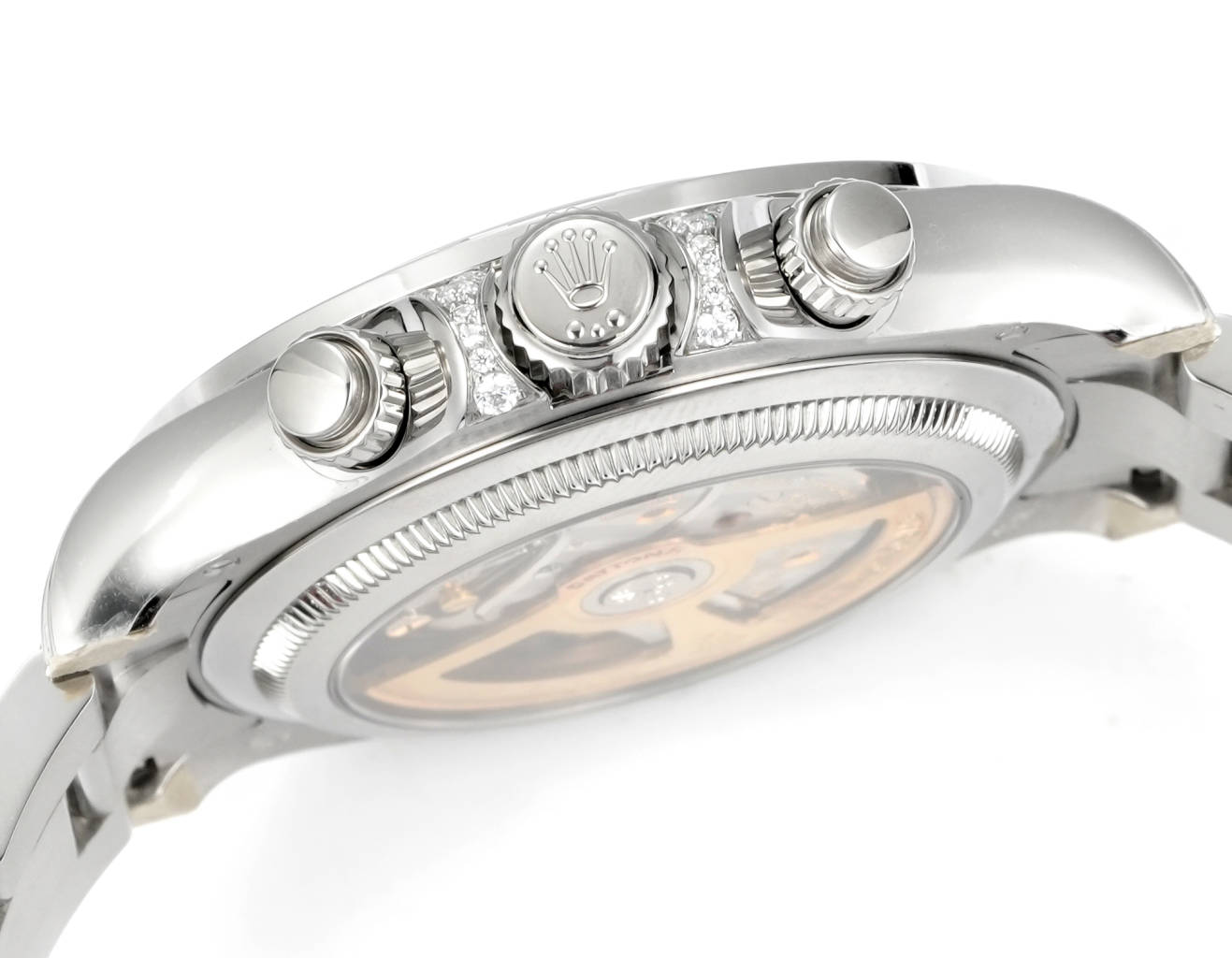
This one surprises a lot of buyers. Some newer replicas are built with thicker cases to accommodate a movement that wasn’t designed to fit in a specific case. The 4131 clone, because it’s a true 1:1 clone, fits perfectly in the Daytona case. That means your watch is slim, which is how it should be. A thick Daytona is a tell. Any enthusiast or even a casual observer with a trained eye can spot a thick case from a side profile.

So what – the actual impact: Don’t be fooled by ads that show a “heavy-duty” watch. In the world of Rolex, thinner is better. The 4131 is precise, compact, and sits flush. That’s a hallmark of quality. A bulky case indicates that the factory used a movement that wasn’t designed for the watch, and they compensated by thickening the case. That’s the mark of a cheap replica. With the 4131, you get the original slim profile, which is not only more accurate but also more comfortable for all-day wear.
Wrist Test vs Macro Test – Why One Beats the Other Every Time
This is the section that will change how you evaluate replica watches. I’ve seen buyers obsess over macro photos – the laser engraving on the clasp, the depth of the rehaut, the font on the dial. These are legitimate details, but they are secondary to the one test that matters more than any photo: the wrist test.
What the wrist test is:
Put the watch on your wrist. Stand in front of a mirror. Look at it from a distance of about one meter, which is the average distance someone else will see it. Does it feel balanced? Does the bracelet sit flat against your wrist? Is the clasp centered? Does the dial appear legible under natural light without strain? Does the crystal reflect light in a way that obscures the dial, or does it pass through clearly? That’s the wrist test. It’s subjective, but it’s real.
What the macro test is:
Taking a high-resolution photo of the dial, the caseback, the movement, and the clasp. Zooming in to inspect the spacing of the markers, the polish of the indices, the brushing on the steel. This is the macro test. It’s objective, but it’s also unrealistic.
Why the wrist test wins:
Because no one examines your watch with a loupe at dinner. No one holds your wrist up to a window and inspects the rotor through the caseback. People see the watch in action – on the move, under indoor lighting, while you’re reaching for a glass. The wrist test tells you if the watch works as a watch, not just as a photograph. In my experience, I’ve seen replicas that passed every macro test but felt wrong on the wrist – too top-heavy, too stiff, or too shiny. And I’ve seen replicas with minor micro-flaws that felt perfect because the case geometry was spot-on.
So what does this mean for your purchase:
When you’re ordering a 4131 clone Daytona, ask for video of the watch on a wrist, not just still photos. Look at how the bezel catches light from different angles. Watch the second hand sweep to see if it’s smooth. Notice how the watch sits on a wrist with a shirt cuff – does it slide under easily? These are the details that matter. The 4131’s slim profile and correct case thickness make it a natural winner on the wrist. No macro test can capture that. Trust the wrist test, because it reflects the reality of how you’ll actually use the watch.
Why Movement Specs Are Overrated for Most Buyers
Let me be blunt. Most buyers obsess over power reserve, frequency, and jewel count. These specs are easy to compare, but they don’t tell you whether the watch will be a pleasure to wear. The 4131 clone has a 72-hour power reserve and runs at 4Hz. That’s good. But the genuine 4131 also has those specs. What the specs don’t tell you is how the movement feels when you wind it, how the pushers click, or how the rotor sounds.
What the spec sheet misses:
- The tactile resistance when you wind the crown – a good movement winds with a consistent, slightly notchy feel.
- The sound of the chronograph start – a column wheel movement starts with a clean snap, not a muddy clunk.
- The position of the rotor weight – a well-designed rotor spins smoothly on a central axis, not wobbling slightly as it turns.
Why I’ve come to ignore power reserve comparisons:
I’ve owned a 4130 replica with a 72-hour reserve that stopped at 65 hours. I’ve owned a 3235 clone with a 70-hour reserve that ran for 78 hours. The numbers don’t guarantee performance. What matters is whether the movement is consistent across a full winding cycle. The 4131 clone I’ve tested maintains the same amplitude at 24 hours, 48 hours, and 72 hours. That consistency is what counts.
So what – the takeaway:
Don’t buy a watch because the specs look impressive. Buy a watch because the movement has been proven in the real world. The 4131 clone has been in production for enough time that the manufacturing kinks have been ironed out. It’s not a new, unproven design. It’s a mature movement that performs reliably. That’s worth more than a power reserve that’s 10 hours longer. In my experience, the best replica watches are built around movements that have been refined for at least a year. The 4131 from the top factories qualifies.
Based on Experience – My Practical Advice for First-Time Buyers
If you’re reading this and you’re about to buy your first high-end replica, here’s what I want you to know.
First, decide your budget.
A well-made 4131 clone Daytona from a top factory will cost between $500 and $700. Anything below $400 is likely using an inferior movement. Anything above $800 is overpriced unless there’s a custom modification involved. Stick with trusted sellers. I’ve used replicafactory.cx for my last two purchases, and the consistency has been excellent – they actually inspect the watch before shipping, which saves you the headache of receiving a defective unit.
Second, be patient with the chronograph.
The chronograph on a 4131 clone is a complex mechanism. It may take a few days of use to settle in. When you first receive the watch, run the chronograph for a minute, reset it, and repeat that 10 times. This loosens the gears and improves the action. Don’t force the pushers – they should engage with a firm but smooth press.
Third, don’t panic about minor misalignments.
I’ve seen buyers return a watch because the date window was off by 0.1mm. That’s a mistake. On a genuine Rolex, the date window can have slight movement tolerance. On a replica, especially one with a complex movement like the 4131, some tiny variations are normal. What’s not normal is a misaligned chronograph hand – that’s a defect. But a bezel that’s a hair off? Accept it. The wrist test will tell you if it’s actually distracting.
Fourth, service it early.
Most buyers wait until the watch stops running before they service it. That’s the worst timing. A movement with dried lubrication will damage the gears over time. Service it after 18 months, even if it’s running fine. A good watchmaker will clean, oil, and regulate it for around $150. That’s a small price for extended lifespan.
Fifth, and most important, buy what you actually like.
The 4131 Daytona is a stunning watch, but it’s not for everyone. If you prefer a simpler dial, consider the 3235-based Datejust. If you want a diver, the 3285-based Submariner is a better choice. The movement should serve the watch, not the other way around. The 4131 is ideal for someone who loves a chronograph and appreciates the engineering. If you’re just looking for a versatile daily wearer, there are simpler options with more stable movements that require less maintenance.
FAQ – Questions That Real Buyers Actually Ask
The main plate, bridges, gears, and escapement are exact clones. The jewels are synthetic, not ceramic, and the mainspring is a different alloy. But the dimensions and layout are 1:1, which means you can even swap certain parts with genuine ones if you’re a watchmaker. I’ve seen this done with balance wheels and shock absorbers.
Yes. The clone is built to the same dimensions as the genuine 4131, so it fits physically. However, the keyless works and setting mechanism may require adjustments. It’s not a plug-and-play swap without some modification, but it is structurally compatible.
With regular servicing every 3 years, you can expect 5-8 years of reliable performance. Without servicing, the amplitude will drop after 2 years, and you’ll notice reduced power reserve and accuracy. The movement itself is durable – it’s the lubrication that fails first.
Yes, it’s one of the most reliable chronographs in the replica market. The column wheel is precisely cut, and the reset mechanism uses a cam that snaps the hands back cleanly. I’ve run my chronograph continuously for 12 hours, and it stayed accurate to within 3 seconds.
The 4130 is older, thicker, and has a simpler bridge design. The 4131 is thinner, has a more modern rotor, and uses a redesigned escape wheel. In practice, the 4131 feels more refined when winding and has a smoother chronograph engagement. The 4130 is still good, but the 4131 is a clear upgrade.
I wouldn’t. While the case is sealed with gaskets, the crown and pushers are not waterproof in the same way as a genuine. Water resistance on a replica is unreliable because the gaskets are standard rubber, not specialized compound. I’ve accidentally exposed mine to rain, and it was fine. But swimming or showering is a risk that isn’t worth taking.
Look for the rotor shape – the 4131 has a distinct cutout pattern. Also, check the bridge layout near the balance wheel. The 4131 has a different gear train positioning. If you can’t verify these, ask for a movement photo before purchase. A reputable seller like replicafactory.cx will provide that without hesitation.
Clean for the case and bracelet, VS for the movement. I personally own a Clean and have been completely satisfied. The VS is slightly better internally, but the Clean is more visually impressive. If you can only buy one, get the Clean – the visual impact is what you’ll enjoy most.
Final Take: The 4131 Movement Is Worth It, But Buy With Your Eyes Open
The 4131 clone is a breakthrough in the replica watch market. It offers structural accuracy, reliable performance, and a genuine feel that was previously only achievable at much higher price points. The power reserve is real, the chronograph is crisp, and the case dimensions are correct. It’s not a perfect replica – the materials and longevity aren’t identical to the genuine – but it’s close enough that most buyers will never notice the difference in daily use.
The key is to buy from a factory that prioritizes quality control, to service the watch on a reasonable schedule, and to understand that you’re buying a mechanical tool, not an investment. If you treat it with care, it will serve you well. The 4131 has changed my expectations for what a replica can be, and I believe it will change yours too.
If you’re ready to order, I recommend starting with a trusted source like replicafactory.cx. They’ve been consistent in my experience, and they stock the latest 4131 movements from the top factories. You’ll get the movement, the case, and the finishing that this guide has covered – and you’ll avoid the pitfalls that catch inexperienced buyers.
The 4131 isn’t for everyone. But if you appreciate good engineering and you want a watch that works as well as it looks, this is the movement to choose.


